
Author: Tipsy Batta
Estimated Read Time: 17 minutes
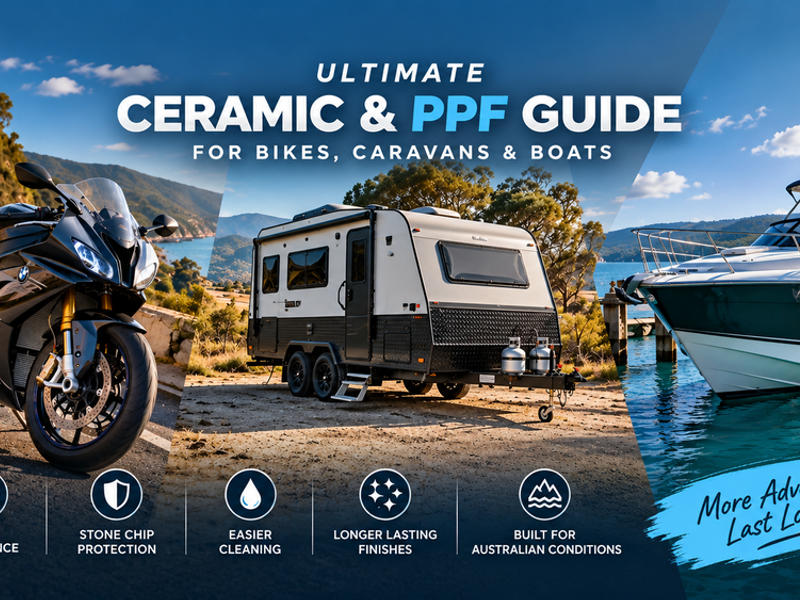
Ceramic coating and Paint Protection Film—better known as PPF—are often discussed in relation to cars. But motorcycles, caravans and boats can benefit just as much, and in some cases even more, from professionally selected surface protection.
The challenge is that these vehicles are far more complicated than simply applying the same automotive product to a different shape.
A motorcycle may combine painted fairings, exposed carbon fibre, matte panels, aluminium, plastic, vinyl graphics and heat-sensitive components within a very small area. A caravan may have gelcoat, painted aluminium, composite panels, acrylic windows, decals, rubber seals and textured surfaces. A boat must survive UV exposure, salt spray, mineral deposits, oxidation, bird droppings and constant contact with water.
That means protection needs to be surface-specific rather than vehicle-specific.
In this guide, we will explain where ceramic coating works, where PPF works better, where combining the two makes sense, and where neither should be applied without specialist advice.
For more information about Gleamoo and our approach to professional vehicle care, visit our About Us page.
Ceramic Coating vs PPF: They Protect Against Different Things
One of the biggest mistakes owners make is assuming that ceramic coating and PPF perform the same job.
They do not.
What Ceramic Coating Does
A ceramic coating is a liquid protective product applied over a correctly prepared surface. Once cured, it creates a thin protective layer designed to improve characteristics such as:
-
Water repellency
-
Dirt release
-
Resistance to environmental contamination
-
Resistance to some chemicals
-
UV protection
-
Gloss retention
-
Ease of maintenance
-
Resistance to light wash-induced marring
Marine-specific coatings are also formulated to cope with demanding environments such as salt spray, UV radiation and contamination on gelcoat and marine topcoats.
Ceramic coating does not, however, create an impact-resistant shield capable of stopping significant stone chips.
If you are new to coating technology, our Ultimate Ceramic Coating Guide for Australian Cars explains the fundamentals in greater detail.
You can also read How Ceramic Coating Really Works for a deeper explanation of what a coating can—and cannot—do.
What PPF Does
Paint Protection Film is a physical transparent or satin film applied over compatible finished surfaces.
Its primary advantage is mechanical protection.
Depending on the film and installation, PPF can help reduce damage from:
-
Stone chips
-
Gravel
-
Road debris
-
Minor scratches
-
Scuffs
-
Bug impacts
-
Light abrasion
-
Tank-contact wear on motorcycles
-
Loading and handling marks
Many modern premium films also have self-healing top layers capable of reducing the appearance of light surface scratches, although deeper cuts through the film will not simply disappear.
For a dedicated comparison, read our Ceramic Coating vs Paint Protection Film Guide.
Quick Comparison
| Protection Need | Ceramic Coating | PPF |
|---|---|---|
| UV resistance | Excellent with suitable coating | Good with quality film |
| Hydrophobic behaviour | Excellent | Depends on film/topcoat |
| Easier washing | Excellent | Good |
| Stone-chip protection | Minimal | Excellent |
| Minor scratch resistance | Moderate | Excellent |
| Chemical resistance | Good to excellent | Good |
| Gloss enhancement | Excellent | Excellent with gloss film |
| Physical thickness | Very thin | Much thicker physical layer |
| Complex shapes | Usually easier | Installation can be difficult |
| Large surfaces | Practical | Can become expensive |
| Marine exposure | Excellent with marine-specific system | Application-dependent |
| Maintenance | Regular gentle washing | Regular gentle washing |
For high-value assets, the strongest solution is often not choosing one over the other—it is using them strategically together.
The Layered Protection Approach
A professional protection strategy usually starts by asking:
What type of damage is this particular area actually exposed to?
For example, coating the front fairing of a highway motorcycle may make bug residue easier to remove, but it does relatively little against a stone travelling towards the paint at speed.
PPF is better suited to that risk.
Meanwhile, covering an entire large caravan in PPF may be unnecessary and expensive when the majority of its side panels mainly need protection from UV exposure, dirt, oxidation and staining.
A more logical combination could be:
High-impact areas → PPF
Large environmental-exposure areas → Ceramic coating
Critical high-impact areas → PPF + compatible ceramic coating
This layered approach is particularly useful for expensive motorcycles, luxury caravans, performance boats and other assets where preserving original finishes matters.
Manufacturers of premium PPF systems also recognise coating-over-film configurations, provided compatible products and correct installation procedures are used.
Motorcycle Ceramic Coating and PPF
Motorcycles are among the best candidates for strategic rather than blanket protection.
Unlike a car, almost every visible section of a motorcycle can be exposed directly to road debris, bugs, shoes, knees, riding gear, fuel spills or weather.
At the same time, motorcycles contain numerous surfaces that should never be treated indiscriminately.
Best Areas for Motorcycle PPF
PPF can be particularly valuable on:
-
Fuel tanks
-
Tank knee-contact zones
-
Front fairings
-
Headlight surrounds where compatible
-
Front mudguards
-
Side fairings
-
Lower belly pans
-
Panniers
-
Painted luggage boxes
-
Areas contacted by boots
-
Areas rubbed by riding gear
The fuel tank is one of the highest-value areas.
Repeated contact from jackets, zippers, belt buckles and riding trousers can create fine scratching surprisingly quickly.
A correctly installed PPF section provides a sacrificial barrier between the rider and the original finish.
Best Areas for Motorcycle Ceramic Coating
Ceramic coating can be useful on compatible:
-
Painted fairings
-
Clear-coated carbon fibre
-
Fuel tanks
-
Painted mudguards
-
Wheels
-
Metal components where the coating is specifically suitable
-
Windscreens where an appropriate product is approved
-
Gloss plastics
The benefit is particularly noticeable when removing:
-
Road grime
-
Bugs
-
Light tar contamination
-
Dust
-
Rain deposits
-
Traffic film
However, coating does not mean contamination can safely be left on the motorcycle indefinitely.
For example, insect residue and bird droppings can contain chemicals capable of affecting finished surfaces. Our guide to Bird Droppings and Paint Protection explains why quick, gentle removal still matters.
Motorcycle Areas That Need Special Caution
Do not simply coat everything that looks shiny.
Particular caution is required around:
-
Brake rotors
-
Brake pads
-
Tyres
-
Foot controls
-
Hand grips
-
Seat contact surfaces
-
Exhaust systems
-
Very high-temperature areas
-
Uncoated raw materials
-
Instrument screens
-
Matte finishes
Anything related to braking, grip or rider control must be treated as a functional safety component first and a detailing surface second.
Generic ceramic products should never contaminate tyre tread or brake friction surfaces.
Standard Motorcycles vs Luxury and Exotic Bikes
Standard and Daily-Use Motorcycles
For commuter motorcycles, scooters and everyday touring bikes, protection should emphasise:
-
Durability
-
Easy cleaning
-
Bug removal
-
Weather resistance
-
Tank protection
-
Lower maintenance time
-
Cost effectiveness
Partial PPF on the tank and leading edges combined with ceramic protection across appropriate painted surfaces often gives excellent practical value.
Luxury, Exotic and Collector Motorcycles
A Ducati Panigale, BMW M-series bike, MV Agusta, limited-production Harley-Davidson or collector motorcycle requires a different mindset.
The goal becomes:
preservation first.
On these vehicles, excessive polishing, inappropriate chemicals or poorly installed film can sometimes create more harm than the contamination being removed.
Special attention may be required for:
-
Thin or sensitive clear coats
-
Exposed carbon fibre
-
Clear-coated carbon fibre
-
Matte and satin body panels
-
Factory graphics
-
Hand-painted details
-
Decals underneath clear coat
-
Special-edition finishes
-
Anodised components
-
Polished aluminium
-
Alcantara or suede-style seat materials
Clear-coated carbon fibre can often be protected much like paint, provided its condition and coating system are correctly assessed.
Raw or speciality carbon surfaces require greater caution.
Matte motorcycles also require finish-matched products. Applying a gloss-enhancing product over a factory satin surface can permanently change its visual character.
The same preservation-first principle applies to exotic cars such as Ferrari, Lamborghini and Porsche: protecting the factory material is more important than simply making everything as glossy as possible.
Ceramic Coating for Caravans
Australian caravans experience a completely different combination of stresses.
A caravan may remain outside for months at a time, travel thousands of kilometres through dusty environments and then sit near the coastline exposed to salt-laden air.
Unlike most cars, its roof and upper surfaces may receive almost uninterrupted UV exposure.
Common Caravan Exterior Materials
Depending on construction, a caravan may contain:
-
Painted aluminium
-
Composite aluminium panels
-
Fibreglass
-
Gelcoat
-
Plastic trim
-
Vinyl graphics
-
Acrylic windows
-
Polycarbonate components
-
Powder-coated metal
-
Rubber seals
-
Silicone or polyurethane sealants
-
Textured stone guards
Each can react differently to chemicals, polishing and coatings.
That is why a professional should identify the substrate before choosing the protection chemistry.
Where Ceramic Coating Makes Sense on a Caravan
Suitable coatings may help protect large caravan surfaces from:
-
UV exposure
-
Road film
-
Bug residue
-
Bird droppings
-
Tree sap
-
Rainwater contamination
-
Black streaks
-
Dust
-
Mild chemical exposure
They also reduce surface energy, helping dirt release more easily during future washing.
If your caravan is frequently stored underneath trees, our guide to Removing Tree Sap Safely is particularly relevant.
Caravan Front Sections
The front of a caravan experiences a completely different type of damage to the sides.
It may be constantly hit by:
-
Stones
-
Gravel
-
Sand
-
Insects
-
Tyre debris
-
Road contamination
This is where PPF or another purpose-designed physical protection system may offer more useful protection than ceramic coating alone.
Possible PPF zones include:
-
Front nose sections
-
Lower front panels
-
Smooth painted stone-impact areas
-
Compatible painted sections around front storage areas
However, textured stone guards and irregular substrates may not be suitable for conventional automotive PPF.
Be Extremely Careful Around Caravan Decals and Windows
Caravan graphics can deteriorate differently from the surrounding panel.
Before polishing, coating or applying PPF over graphics, consider:
-
Age
-
Adhesive condition
-
UV degradation
-
Cracking
-
Lifting edges
-
Previous chemical exposure
Aggressive machine polishing across old decals can damage them.
Likewise, caravan windows are often acrylic rather than automotive glass.
A chemical or abrasive product that is perfectly acceptable on glass can damage acrylic.
Never assume a window is glass simply because it is transparent.
Ceramic Coating for Boats
Boats are arguably one of the strongest use cases for specialised protective coatings because the marine environment continuously attacks exposed surfaces.
Typical threats include:
-
Intense UV radiation
-
Salt spray
-
Salt crystals
-
Water spotting
-
Minerals
-
Bird droppings
-
Fish residue
-
Fuel residue
-
Oxidation
-
Dock contamination
-
Atmospheric pollution
Marine ceramic products are specifically available for gelcoat and topcoat surfaces and are designed to improve resistance to UV exposure, salt contamination and oxidation while making washing easier.
Gelcoat Is Not the Same as Automotive Clear Coat
One of the biggest mistakes in boat detailing is treating gelcoat exactly like automotive paint.
Gelcoat tends to be considerably thicker, but it can also become porous and heavily oxidised.
A faded hull may therefore require substantial preparation before protection.
Applying ceramic coating over oxidised gelcoat simply locks in a poor finish.
The correct sequence is generally:
clean → decontaminate → assess → correct/polish → degrease → protect
Surface preparation matters enormously because the coating needs a clean and stable substrate.
Professional marine coating manufacturers similarly specify polishing where necessary and thorough surface degreasing before coating application.
Can You Put PPF on a Boat?
Yes—but selectively.
PPF can be useful on certain smooth, compatible above-waterline surfaces such as:
-
Painted sections
-
Console areas
-
High-wear surfaces
-
Loading zones
-
Selected topside areas
-
Areas vulnerable to equipment contact
However, conventional automotive PPF should not automatically be assumed suitable for:
-
Permanently submerged hull areas
-
Antifouling coatings
-
Highly textured surfaces
-
Flexible substrates
-
Non-skid deck surfaces
-
Areas experiencing prolonged water immersion
The film manufacturer and installer should approve the exact use.
Water constantly attacking exposed film edges is very different from rain hitting a car.
A boat therefore requires a marine-specific assessment rather than a simple automotive film installation.
What About Below the Waterline?
The below-waterline portion of a boat has different requirements.
It may require systems designed specifically for:
-
Marine fouling
-
Continuous immersion
-
Antifouling compatibility
-
Osmosis management
-
Underwater coatings
Do not assume a normal automotive ceramic coating or automotive PPF replaces proper antifouling or marine hull protection.
These are separate systems designed for separate problems.
Be Careful With Non-Skid Boat Decks
A glossy, slippery surface may look impressive—but it can be dangerous on a walking area.
Generic automotive coatings should not automatically be applied to non-skid decks.
Any product used on:
-
Steps
-
Swim platforms
-
Walkways
-
Decks
-
Boarding areas
must be specifically suitable for that surface and must not create an unacceptable loss of traction.
Safety always overrides gloss.
Standard Boats vs Luxury and High-Value Marine Assets
Everyday Recreational Boats
For fishing boats, family boats and weekend cruisers, priorities typically include:
-
Easier salt removal
-
Oxidation resistance
-
UV protection
-
Easier maintenance
-
Reduced staining
-
Gelcoat gloss preservation
A quality marine coating after suitable correction can substantially reduce the effort required to keep surfaces clean.
Luxury Boats and High-Value Vessels
For premium yachts, performance boats and collector vessels, preservation becomes the priority.
Before aggressive polishing, the detailer should establish:
-
Surface type
-
Gelcoat condition
-
Paint system
-
Existing coating history
-
Thickness where measurable
-
Previous repairs
-
Graphic condition
-
Sensitive trim
Repeated heavy compounding should never become a substitute for good maintenance.
Every correction removes some material.
On valuable assets, the best correction is the least aggressive process capable of producing the required result.
Australian Climate Considerations
Australia is particularly demanding on exposed surfaces.
The correct protection strategy can vary significantly depending on where and how an asset is stored.
Sydney
Sydney combines strong UV exposure with coastal salt, humidity, rain contamination and tree-related fallout.
Motorcycles and caravans stored near the coast may accumulate invisible salt contamination even when they have not been directly splashed with seawater.
Boats obviously experience even greater exposure.
Melbourne
Melbourne's rapidly changing weather can expose surfaces to repeated cycles of:
-
Moisture
-
Drying
-
Dust
-
Temperature fluctuation
Repeated water spotting becomes particularly noticeable on dark gloss surfaces.
Brisbane
Heat, humidity, intense UV exposure and insect contamination are major considerations.
Bug residue on motorcycle fairings should be removed promptly rather than scrubbed once hardened.
Adelaide
Strong sun, dry conditions and airborne dust can gradually reduce gloss.
Dust should never simply be wiped from dry surfaces because the particles themselves can produce micro-scratching.
Perth
Perth combines very strong sunlight with extensive coastal exposure.
For caravans stored outdoors or boats kept near the coast, maintaining protective surfaces and regularly removing salt contamination is particularly important.
No ceramic coating makes an asset "salt-proof" or "UV-proof."
Protection buys you resistance and maintenance advantages—not immunity.
Can Ceramic Coating Prevent Bird Dropping and Tree Sap Damage?
It can provide an additional sacrificial barrier, but contamination should still be removed quickly.
Highly alkaline or acidic contamination may eventually compromise protection.
Read our guide Can Ceramic Coating Stop Bird Poo and Tree Sap Damage? for a fuller explanation.
This is especially important for:
-
Boat covers and topsides
-
Caravan roofs
-
Motorcycles parked outdoors
-
Assets stored underneath trees
Protection should make contamination safer and easier to remove.
It should never be treated as permission to ignore contamination.
Professional Step-by-Step Ceramic Coating and PPF Process
The exact process varies by surface, but a professional workflow generally follows the same principles.
1. Inspect Every Surface
Before washing, identify:
-
Paint type
-
Gelcoat
-
Carbon fibre
-
Matte surfaces
-
Vinyl
-
Graphics
-
Plastics
-
Rubber
-
Acrylic
-
Glass
-
Metal
-
Previous coatings
-
Existing PPF
-
Oxidation
-
Repairs
This prevents the "one chemical everywhere" approach that causes many detailing problems.
For expensive assets, inspection also establishes what should be preserved rather than corrected.
2. Assess Existing Damage
Protection cannot repair:
-
Deep scratches
-
Stone chips
-
Cracked gelcoat
-
Delamination
-
Failing clear coat
-
Peeling decals
-
Corrosion
-
Structural damage
These issues should be identified before coating or film installation.
Protection is the final stage—not a substitute for repair.
3. Carry Out a Safe Pre-Rinse Where Appropriate
Loose dirt should be removed before physical contact.
This is particularly important on:
-
Caravan lower panels
-
Boat hulls
-
Motorcycle belly pans
-
Front fairings
Grinding loose contamination into a surface during washing creates unnecessary marring.
4. Perform a Gentle Contact Wash
Use surface-compatible cleaners, clean wash media and correct washing techniques.
A proper hand wash remains one of the safest approaches for sensitive finishes when performed correctly.
Our Ultimate Hand Car Wash Guide explains the fundamentals.
You may also find our article Why Hand Washing Is Still the Safest Car Wash Choice useful.
For heavily contaminated surfaces, a waterless wash should not automatically replace a conventional wash. Our guide to When a Waterless Car Wash Can Damage Paint explains why contamination level matters.
5. Chemically Decontaminate Where Appropriate
Depending on the substrate, contaminants may include:
-
Iron particles
-
Tar
-
Mineral deposits
-
Salt
-
Organic contamination
-
Road film
Products must be chosen for the exact substrate.
A chemical safe for automotive clear coat may not necessarily be safe for acrylic, decals or polished metal.
6. Mechanically Decontaminate Only When Needed
Clay media may be appropriate on some smooth surfaces, but it can introduce light marring.
On sensitive, matte or delicate substrates, traditional claying may be inappropriate.
The professional goal is not to perform every possible detailing step.
It is to perform only the steps the surface actually needs.
7. Correct Defects Before Protection
Gloss paint or gelcoat may require polishing to remove:
-
Oxidation
-
Swirls
-
Light scratches
-
Water marks
-
Haze
-
Previous polishing defects
Once ceramic coating or PPF is installed, existing imperfections remain underneath.
That is why preparation often contributes more to the final appearance than the protection product itself.
Our Paint Correction vs Detailing Guide explains this distinction.
DIY correction can also carry risks. If you are considering polishing yourself, read our DIY Paint Correction Guide.
8. Perform Final Surface Preparation
Polishing oils and residue must be removed using a product appropriate for the substrate and chosen protection system.
This stage creates a clean bonding surface.
Poor preparation can contribute to:
-
Coating failure
-
Uneven behaviour
-
PPF adhesion problems
-
Contamination trapped underneath film
Cleanliness at this stage is critical.
9. Install PPF First Where Required
Where PPF and ceramic coating are being combined, the film is normally installed before the coating.
Complex panels require particular skill.
Motorcycles are especially challenging because fairings can contain:
-
Sharp curves
-
Recesses
-
Vents
-
Panel edges
-
Tight compound shapes
Incorrect stretching can result in:
-
Distortion
-
Lifted edges
-
Excess tension
-
Visible stretch marks
-
Premature failure
Professional installation is strongly recommended for high-value surfaces because positioning, edge management and contamination control are critical to the appearance and longevity of the film.
10. Apply Ceramic Coating to Suitable Areas
Once surfaces are properly prepared, the chosen coating is applied in controlled sections.
The installer monitors:
-
Temperature
-
Humidity
-
Flash time
-
Levelling
-
Lighting
-
Product loading
-
High spots
This matters because an improperly levelled ceramic coating can leave hardened high spots visible under strong light.
Large caravans and boats require especially disciplined section management because of their enormous surface area.
11. Allow the Protection System to Cure
Follow the exact film or coating manufacturer's requirements.
During the initial curing period, avoid:
-
Washing too soon
-
Strong detergents
-
Abrasive contact
-
Unnecessary water exposure
-
Aggressive wiping
-
Pressure washing film edges
Initial care requirements differ by product.
For PPF in particular, high-pressure water should not be directed into film edges because this can contribute to lifting.
12. Conduct Final Inspection
Inspect under suitable lighting for:
-
Coating high spots
-
Missed areas
-
Film contamination
-
Bubbles
-
Lifted edges
-
Distortion
-
Adhesion problems
On motorcycles, special attention should be paid around tight edges and complex fairings.
On caravans, inspect long edges and graphic transitions.
On boats, inspect any film or protection near areas exposed to concentrated water flow.
Maintaining Ceramic-Coated Motorcycles, Caravans and Boats
Protection only performs well when maintained properly.
Wash Regularly
Do not wait until a surface is heavily contaminated.
The longer contamination remains, the more difficult safe removal becomes.
Washing frequency should reflect actual use and storage conditions rather than a fixed calendar.
Our guide to How Often You Should Wash Based on Driving Habits explains this principle.
Use Soft Microfibre
Low-quality or dirty towels can damage even protected surfaces.
Read Why Microfiber Towels Matter for guidance on reducing wash-induced marring.
Avoid Aggressive Automatic Brushes
PPF and ceramic coatings do not make a finish immune to poor washing techniques.
Repeated contact with aggressive automatic brushes can still introduce scratching or affect the protection system.
This is why we recommend careful hand washing for valuable finishes. Our Hand Wash vs Automatic Car Wash comparison explains the difference.
Do Not Pressure-Wash PPF Edges
High-pressure water concentrated at close range can lift film edges.
Keep the pressure washer at a sensible distance and direct the spray away from exposed film edges rather than underneath them.
Remove Contamination Quickly
Do not allow these to remain indefinitely:
-
Bird droppings
-
Insects
-
Fuel spills
-
Tree sap
-
Salt
-
Hard-water deposits
-
Fish residue
-
Road tar
Ceramic coating delays or reduces contamination bonding—it does not make the underlying surface invincible.
Special Maintenance for Boats
Whenever practical, rinse salt contamination from marine surfaces after use.
Salt crystals remaining on a surface can:
-
Attract moisture
-
Create deposits
-
Increase cleaning difficulty
-
Become abrasive during poor washing
Use marine-compatible products rather than assuming automotive chemicals are always interchangeable.
Special Maintenance for Caravans
Pay particular attention to:
-
Roof areas
-
Window edges
-
Sealant lines
-
Lower panels
-
Front impact areas
-
Awning hardware
-
Decals
The roof may deteriorate long before eye-level panels because owners rarely inspect it.
Protection systems should therefore be inspected rather than forgotten.
Special Maintenance for Motorcycles
After long rides, inspect:
-
Leading fairings
-
Fuel tank
-
Lower engine area
-
Wheels
-
Mudguards
-
PPF edges
Avoid aggressive scrubbing to remove insects.
Soften contamination first and allow chemistry to perform as much of the cleaning as possible.
Common Ceramic Coating Mistakes
Thinking Ceramic Coating Is Scratch-Proof
Ceramic coating does not make paint scratch-proof.
Poor washing can still create defects.
For more examples, read 6 Ceramic-Coated Car Wash Mistakes to Avoid.
Coating Over Oxidation
This is particularly common with caravans and boats.
Protection should be applied to a correctly prepared finish, not used to hide deteriorated surfaces.
Using Automotive Products on Every Marine Surface
Marine environments have unique chemistry and exposure requirements.
Use purpose-designed products where appropriate.
Coating Safety-Critical Surfaces
Never prioritise hydrophobic behaviour over:
-
Tyre grip
-
Brake performance
-
Deck traction
-
Rider contact
-
Footing
Assuming PPF Works Everywhere
Film needs a stable, suitable substrate.
Highly textured surfaces, failing finishes, flexible sealants and continuously immersed surfaces require specialist assessment.
Standard/Daily Use vs Preservation-First Protection
The budget and strategy should match the value and intended use of the asset.
Daily-Use Protection
For regularly used motorcycles, caravans and family boats, concentrate spending on:
-
High-impact areas
-
High-UV areas
-
Difficult-to-clean areas
-
Areas likely to affect resale condition
The goal is maximum practical benefit.
Luxury and Exotic Protection
For high-value vehicles and vessels, the priority changes.
Ask:
-
Can the original finish be preserved?
-
Is machine polishing actually necessary?
-
Could polishing alter the factory texture?
-
Will film edges be visible?
-
Will removing the film later affect old graphics?
-
Is the surface factory-original or previously repaired?
-
Is replacement paint readily available?
-
Could changing a matte finish affect asset value?
This is the preservation-first mindset.
On a rare motorcycle, premium caravan or luxury vessel, removing a defect is not always worth sacrificing original material.
Sometimes the technically best detailing decision is to leave a minor imperfection alone.
Ceramic Coating, PPF—or Both?
A useful general framework is:
Choose Ceramic Coating When:
Your primary concerns are:
-
UV
-
Oxidation
-
Dirt
-
Salt
-
Water spotting
-
Easier maintenance
-
Gloss
-
Environmental contamination
Choose PPF When:
Your primary concerns are:
-
Stone chips
-
Gravel
-
Physical abrasion
-
Scratching
-
Equipment contact
-
Boot contact
-
Riding-gear contact
Combine PPF and Ceramic When:
You want:
-
Physical impact protection in vulnerable areas
-
Easier cleaning
-
Improved hydrophobic behaviour
-
Environmental resistance
-
Preservation of an expensive original finish
For many premium motorcycles, a strategic PPF installation followed by a compatible coating is one of the most complete protection combinations available.
For caravans and boats, full PPF coverage usually makes less sense, so selective PPF combined with suitable coating across larger surfaces is often the more rational approach.
Pro Tip: Protect According to Exposure, Not Price
The most expensive protection package is not automatically the best one.
Map the asset into zones.
For example:
Motorcycle
Front fairing → high impact → consider PPF
Fuel tank → abrasion → consider PPF
Side panels → contamination/UV → ceramic coating
Wheels → grime → compatible ceramic coating
Caravan
Front lower panel → stone impact → consider PPF/physical protection
Large side panels → UV and dirt → ceramic coating
Roof → UV/contamination → suitable coating
Acrylic windows → specialist treatment only
Boat
Gelcoat topsides → UV/salt → marine ceramic coating
Loading contact areas → abrasion → consider compatible PPF
Non-skid deck → traction first
Below waterline → dedicated marine system
This produces a better result than treating every square centimetre identically.
Frequently Asked Questions
1. Is ceramic coating worth it on a motorcycle, caravan or boat?
It can be, particularly when the asset receives significant UV exposure, environmental contamination or frequent washing.
The value comes from easier maintenance, surface preservation and reduced contamination bonding rather than simply making the surface shiny.
A well-maintained asset may also present better at resale.
For a deeper discussion of coating value, see Is Ceramic Coating Really Worth the Money?.
2. Should I choose PPF or ceramic coating for a motorcycle?
For many motorcycles, the best answer is both—but applied strategically.
PPF works particularly well on:
-
Tanks
-
Front fairings
-
High-impact panels
-
Boot/rider contact areas
Ceramic coating works well across appropriate painted surfaces to improve cleanability and environmental protection.
If your main concern is stone chips, choose PPF first.
If your main concern is easier cleaning and environmental protection, ceramic coating may offer better value.
3. Can ceramic coating stop salt damage on boats?
Ceramic coating can create a valuable protective barrier that makes salt contamination easier to remove and helps protect compatible marine surfaces from environmental exposure.
However, it does not mean you should leave salt deposits permanently on the vessel.
Regular rinsing and correct washing remain essential.
Marine coatings are specifically formulated for harsh conditions such as UV, saltwater and salt spray, but their longevity still depends on preparation and maintenance.
Professional Assistance & Call to Action
Applying ceramic coating to a straightforward panel may look simple in a video.
Preparing an entire motorcycle, caravan or boat correctly is another matter.
Professional protection may involve:
-
Multiple decontamination stages
-
Machine polishing
-
Oxidation removal
-
Specialist lighting
-
Controlled application conditions
-
Surface-specific chemicals
-
PPF installation tools
-
Film patterning
-
Careful edge management
-
Product compatibility testing
DIY detailing can be rewarding, but once you are dealing with a high-value motorcycle, expensive caravan, luxury vessel, sensitive carbon fibre or speciality finish, mistakes can become significantly more expensive than the protection itself.
At Gleamoo, the objective is to use appropriate equipment, preparation methods and protection systems to achieve consistent professional results while minimising avoidable risk to the original surface. No detailing or protection process is completely risk-free, which is why careful inspection and correct product selection matter so much.
For this guide, the most relevant Gleamoo option is Shield Protection, particularly where long-term exterior surface protection is the objective.
Where significant contamination, oxidation or correction is required before protection, Deep Detailing may also be appropriate as part of the preparation process.
Because motorcycles, caravans and boats can involve materials outside normal automotive paint systems, we recommend confirming suitability and service availability with Gleamoo before booking protection for a non-car asset.
If your asset simply needs safe ongoing maintenance before or after protection, you can also explore Gleamoo's Traditional Wash and Waterless Wash options where suitable.
The principle is simple:
Protect impact zones from physical damage. Protect exposed surfaces from the environment. Maintain both correctly.
Whether it is a motorcycle carving through the Blue Mountains, a caravan crossing Western Australia or a boat spending weekends on Sydney Harbour, protection performs best when it is designed around how the asset is actually used.
About the Author
Tipsy Batta, Team Gleamoo
Tipsy Batta is passionate about helping vehicle owners understand professional automotive care without unnecessary jargon. Through Gleamoo's educational guides, Tipsy focuses on practical detailing techniques, paint preservation, ceramic protection and smarter maintenance choices for Australian conditions.
The philosophy is simple: great detailing is not just about creating shine—it is about understanding the material underneath, choosing the least aggressive safe process, and protecting the asset so it can continue looking its best for years to come.