
Author: Tipsy Batta
Estimated Read Time: 11 minutes
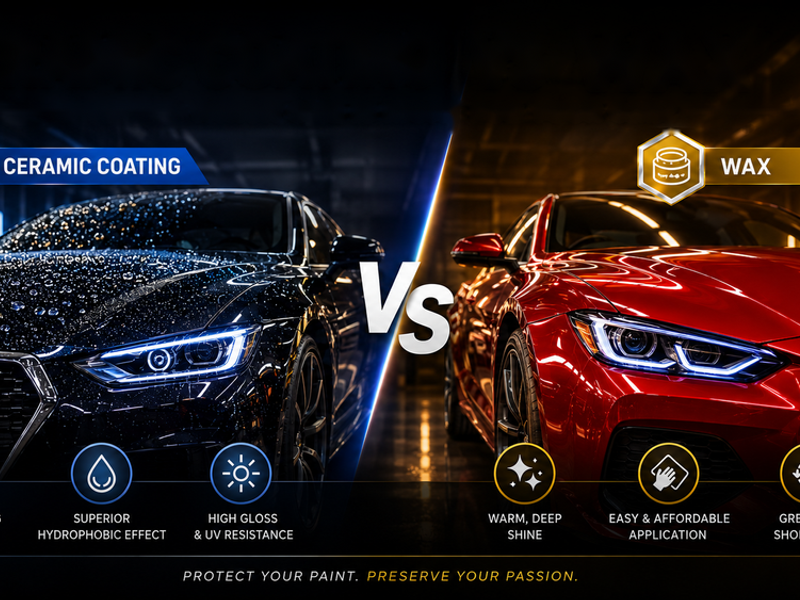
Car paint protection can be confusing. Some car owners swear by traditional car wax because it delivers a deep, warm shine and is highly accessible for DIY enthusiasts. Others firmly prefer a ceramic coating because it offers long-lasting environmental protection, extreme hydrophobic water-beading, and superior resistance against harsh driving conditions.
The truth is simple: while both options shield your vehicle's paintwork, they rely on completely different chemical properties, require different maintenance, last for vastly different lengths of time, and suit entirely different types of car owners.
What is the difference between a ceramic coating and car wax? The main difference lies in their durability and how they bond to your vehicle. A car wax sits loosely on top of the clear coat to provide short-term shine and mild protection for a few weeks or months. In contrast, a ceramic coating chemically bonds to the paintwork on a molecular level, creating a semi-permanent, hardened glass layer that can last for several years when properly maintained.
In this guide, we will break down the ceramic coating vs wax debate from a professional detailing perspective. You will learn exactly how each protection layer works, how they handle the volatile Australian climate, what level of maintenance is required, and which option makes the most sense for daily drivers, high-value luxury cars, exotic supercars, and vehicles being prepared for the private resale market.
What Is Car Wax? Understanding the Traditional Paint Sealant
Car wax is one of the oldest, most traditional forms of automotive paint protection. It is typically formulated from natural substances, such as Carnauba wax harvested from Brazilian palm trees, or blended with synthetic polymers to improve its resilience.
When applied to a clean vehicle, car wax fills in microscopic paint imperfections and sits as a physical sacrificial layer directly on top of the clear coat. It is widely celebrated by enthusiasts because it reflects light in a way that gives the vehicle a warm, deep, organic gloss—an aesthetic that particularly enhances darker paint colours like deep black, navy blue, and rich red.
However, because car wax merely rests on the surface without forming a chemical bond, it is highly sensitive to external heat and abrasive chemicals. It degrades rapidly when exposed to detergents, heavy rain, or high ambient temperatures.
For Australian vehicles frequently exposed to intense UV rays, coastal salt air, acidic bird droppings, sticky tree sap, and harsh road grime, a traditional wax coating can still provide temporary benefits. However, it requires regular reapplication every four to twelve weeks to maintain an effective barrier.
What Is Ceramic Coating? The Modern Liquid Glass Shield
A ceramic coating is a liquid polymer compound made of Silicon Dioxide (SiO2) or Silicon Carbide (SiC) that cures to form a glass-like, transparent protective layer over your vehicle's clear coat. Instead of sitting loosely on the paint, a ceramic coating utilizes nanotechnology to sink into the microscopic pores of the clear coat, creating a permanent or semi-permanent chemical bond.
Once fully cured, a ceramic coating provides a much harder, highly resilient shield that outperforms traditional wax in every performance metric. It acts as an incredibly smooth, hydrophobic surface that actively repels water, road grime, industrial fallout, and metallic brake dust, making the vehicle significantly easier to wash and dry.
It is vital to understand that a ceramic coating is not an indestructible suit of armour. It will not prevent stone chips, it will not stop deep key scratches, and it does not make your car entirely self-cleaning. However, when the paintwork is prepared properly by a professional and the coating is maintained correctly, it provides unmatched chemical resistance, prevents paint oxidation, and preserves a high-gloss, reflective finish for years.
To understand exactly how these modern nano-coatings anchor themselves to your vehicle and what detailed preparation work is required beforehand, read Gleamoo’s Ultimate Ceramic Coating Guide for Australian Cars. If you are still trying to figure out the science behind liquid glass technology, you can also explore our guide on Why Ceramic Coating is Confusing: Here’s How it Really Works.
Why Australian Environmental Conditions Require Robust Paint Protection
Vehicles driven in Australia face some of the most volatile and destructive environmental conditions in the world. The intense climate accelerates paint degradation through constant exposure to harsh elements that vary heavily by region.
-
Sydney & Brisbane: Vehicles regularly contend with high coastal humidity, salt-laden air, urban traffic pollution, and highly acidic bat and bird droppings. When these acids bake into the clear coat under the hot sun, they can permanently etch the paint within hours.
-
Melbourne: Drivers experience sudden, volatile weather changes, meaning a car can be covered in rain, baked by intense sunlight, and blanketed in dusty wind all in a single week. This rapid thermal cycling and drying creates severe mineral water-spot etching on unprotected paint.
-
Adelaide & Perth: Prolonged dry heat waves and exceptionally high UV indexes cause rapid paint oxidation, which breaks down the clear coat, turns exterior black plastics chalky white, and causes vibrant paint pigments to fade or peel over time.
Because these harsh factors are constantly working against your car's finish, applying a dedicated layer of protection is essential to prevent permanent damage. However, protection and proper washing habits must go hand-in-hand. Using automated mechanical brush washes will quickly strip away wax and scratch your ceramic coating with fine swirl marks.
To learn how a meticulous manual wash routine preserves your chosen protection layer, refer to Gleamoo’s Ultimate Hand Car Wash Guide for Every Vehicle Owner. You can also discover the paint-safety differences between manual and automated washing by reading our analysis on Hand Wash vs Automatic Car Wash: Which Protects Paint. Additionally, if you are looking for an eco-friendly, low-moisture maintenance routine between deep cleanings, find out more in our comparison of Waterless vs Hand Car Wash: Which Protects Your Paint.
Ceramic Coating vs Wax: Head-to-Head Detailing Breakdown
1. Durability and Longevity Expectancy
Car wax offers short-term protection, typically lasting anywhere from 4 to 12 weeks. Its lifespan is heavily dictated by how often you wash the vehicle, whether you park it in a garage or outdoors, and how hot the weather is. In contrast, a high-quality ceramic coating can last from 2 to 5+ years depending on the grade of the coating, the precision of the installation, and the ongoing maintenance routine.
For daily drivers parked outside in major Australian cities, a ceramic coating delivers vastly superior long-term value because it does not melt away or degrade under extreme heat and UV exposure.
2. Gloss Levels and Visual Presentation
The aesthetic finishes of these two products are entirely distinct. Car wax produces a warm, deep, organic glow that enhances the curves of classic cars and dark solid paintwork by filling in minor micro-fissures to create a soft look.
A ceramic coating delivers a hard, glassy, razor-sharp reflectivity. It gives the paint an ultra-slick, mirror-like appearance that makes the vehicle look as though it has a wet, liquid-glass shell poured over it. This sharp clarity is highly effective at highlighting the metallic flakes within modern premium paintwork.
3. Hydrophobic Performance and Water Behaviour
While both options repel water initially, a ceramic coating exhibits extreme hydrophobic behaviour that far outlasts wax. The contact angle of water droplets on a ceramic-coated surface is significantly higher, causing water to bead tightly and sheet off effortlessly, taking loose surface dust and dirt with it.
Car wax creates moderate water-beading, but this surface tension weakens rapidly after just a few routine washes, allowing dirt, traffic film, and water spots to stick to the paintwork much more aggressively.
4. Ongoing Maintenance Requirements
Car wax requires high-frequency maintenance, requiring full stripping and reapplication several times a year to keep your paintwork protected. A ceramic coating requires much less frequent reapplication but demands strict, proper washing techniques.
Coated vehicles must be washed with pH-neutral shampoos, clean microfiber mitts, and soft drying towels. Using aggressive, high-pH chemicals or automatic brush car washes will quickly scratch, dull, and clog the coating, reducing its hydrophobic performance.
If you want to master safe maintenance washing at home for your protected vehicle, start by reading Gleamoo’s Hand Car Wash FAQs.
5. Upfront and Long-Term Costs
Car wax is highly budget-friendly upfront, making it ideal for car owners who love spending their weekends performing DIY car care and don't mind the labor-intensive process of regular reapplication.
A ceramic coating requires a higher upfront financial investment because the process demands professional labor, multi-stage machine polishing, precise application, and climate-controlled curing time. However, because it lasts for years and eliminates the need for constant reapplications, waxes, and intense scrubbing, it is often the most cost-effective option for long-term vehicle ownership.
6. Required Paintwork Preparation
Wax is highly forgiving. It can be applied immediately after a standard wash, though it performs better on clean paint.
A ceramic coating is completely unforgiving and requires meticulous, surgical surface preparation. The paint must be fully washed, chemically decontaminated, mechanically clay-barred, and machine polished to remove any swirl marks or paint defects.
Because a ceramic coating is optically clear and semi-permanent, applying it over scratched, oxidised, or dirty paint will lock those defects beneath the glass layer permanently. If your car needs extensive preparation and defect correction before a coating can be safely installed, explore The Ultimate Guide to Full Car Detailing Done Right.
Tailoring Paint Protection to Your Specific Vehicle Class
Daily Commuters, Rideshare Cars, and Family SUVs
For everyday daily drivers, the primary goals of paint protection are efficiency, durability, and minimizing washing effort. If your vehicle is used for heavy commuting, school runs, supermarket parking, or lives outdoors on a driveway exposed to the elements, a ceramic coating is the most practical choice.
It actively prevents road grime, brake dust, and traffic film from binding hard to the paint panels, meaning you can wash the car in half the time. Wax can still provide a beautiful budget-friendly option for daily drivers, but the protection will fade quickly under a heavy driving routine.
A daily driver requires protection that can reliably withstand:
-
Intense UV radiation and clear coat fading
-
Acidic bird droppings and bug splatter etching
-
Abrasive brake dust bonding to lower side skirts
-
Water spot mineral rings from sudden rainstorms
-
Scratches induced by frequent maintenance washing
For daily drivers that accumulate light surface dust rather than thick mud between deep cleanings, utilizing a premium waterless spray is an exceptionally safe and efficient maintenance alternative, as detailed in Gleamoo’s Ultimate Waterless Car Wash Guide for Aussie Drivers.
Luxury Cars, High-Performance Vehicles, and Exotic Supercars
When detailing prestige, exotic, or ultra-high-performance vehicles—such as a Porsche, Ferrari, Lamborghini, Aston Martin, McLaren, Bentley, or high-end Mercedes-AMG or BMW M model—the approach changes completely to a preservation-first mindset. These vehicles are valuable assets that feature incredibly sensitive exterior materials and intricate clear coats.
For exotics, a ceramic coating is highly preferred over car wax because its superior slickness minimizes dirt adhesion. This significantly reduces the frequency of intensive contact washing, which means there are far fewer opportunities to accidentally introduce fine micro-scratches or swirl marks during the wash process.
However, installing protection on an exotic car requires absolute professional precision due to several critical material sensitivities:
-
Soft or Thin Factory Clear Coats: Many prestige brands utilize soft paintwork that requires careful paint depth measurements and low-amplitude machine polishing to avoid burning through the finish.
-
Exposed Carbon Fibre Panels: The resin layer covering carbon fibre is highly sensitive to heat and aggressive friction, requiring specialized, gentle handling.
-
Intricate Grilles and Delicate Badging: Traditional thick paste waxes will easily clog up complex grilles and leave unsightly white chalky residue around badges, whereas an expertly applied ceramic coating flows seamlessly over complex surfaces.
-
Sensitive Interior Fabrics: Exotic cabins featuring delicate Alcantara, fine-grain aniline leather, and contrast stitching require specialized low-moisture cleaning rather than aggressive scrubbing. To ensure your vehicle's cabin receives the exact same preservation-first care as its exterior paintwork, review Gleamoo’s Ultimate Interior Detailing Guide for Every Vehicle.
Vehicles Being Prepared for Private Sale or Dealership Trade-In
If you are currently preparing a vehicle for sale, both wax and ceramic coatings can be utilized to maximize your vehicle’s resale value, but the best option depends on the car's market value.
For an affordable, older used vehicle, having a professional execute a thorough detail followed by a high-grade car wax application is an exceptional, fast way to instantly mask light imperfections, boost gloss, and maximize first impressions for buyers.
For modern, premium, or high-value sports cars and SUVs, having a verified ceramic coating installed can serve as a powerful selling point. Highlighting a long-term, low-maintenance protective coating to prospective buyers builds immediate trust, showing that the asset has been meticulously maintained. To discover how a comprehensive visual overhaul can secure a higher final sale price, consult Gleamoo’s Ultimate Pre-Sale Detail Guide for Australian Cars.
The Professional 10-Step Preparation and Application Process
Achieving flawless paint protection requires a strict, multi-stage decontamination and preparation workflow. Here is the step-by-step process executed during a professional detailing service to safely transition a vehicle into a fully protected finish.
Step 1: In-Depth Paintwork Assessment
The process begins with a comprehensive visual and physical inspection under high-intensity detailing lights. The technician checks for paint depth, pre-existing swirl marks, deep scratches, factory clear coat thinness, stone chips, and aftermarket smart repairs to determine the safest possible preparation method.
Step 2: High-Pressure Debris Removal
The vehicle is subjected to a touchless high-pressure rinse using purified water. This step flushes out abrasive loose sand, heavy grit, mud, and dust from inner wheel arches, body panel seams, window trims, and lower rocker panels before any physical wash mitt touches the car.
Step 3: Premium Manual Hand Wash
The vehicle is washed using a safe multi-bucket technique paired with plush microfiber wash mitts and a premium, lubricated pH-neutral automotive shampoo. This lifts away the remaining film of traffic soot gently, without grinding surface contaminants into the delicate paintwork. To see why this process is universally superior to automatic car washes, read our expert breakdown on Why Hand Washing is Still the Safest Car Wash Choice.
Step 4: Chemical Decontamination (Iron & Tar Removal)
Even after a thorough wash, invisible contaminants remain bonded to the clear coat. Specialized chemical iron-dissolvers are sprayed across the panels to melt away embedded metallic brake dust and industrial rail fallout. A separate tar remover is applied to safely dissolve stubborn road tar, asphalt spots, and organic tree sap.
Step 5: Mechanical Clay Bar Treatment
An ultra-fine detailing clay bar paired with a dedicated surface lubricant is gently glided across the paintwork. This mechanical process safely shears off any remaining microscopic bonded contaminants, pulling them out of the clear coat pores and leaving the paint surface completely smooth to the touch.
Step 6: Multi-Stage Machine Polishing (Paint Correction)
The paintwork is carefully polished using precision dual-action machine polishers. This step eliminates unsightly swirl marks, light oxidation, and surface marring, bringing back optical clarity, color depth, and sharp reflections. This step is critical before a ceramic coating, as any uncorrected scratches will be permanently locked beneath the cured coating.
Step 7: Isopropyl Alcohol (IPA) Surface Wipe-Down
The entire vehicle is wiped down using a specialized panel preparation spray or an Isopropyl Alcohol solution. This dissolves and completely removes any leftover polishing oils, lubricants, or silicone residues, ensuring the paint panels are chemically bare and ready for optimal protection adhesion.
Step 8: Precise Protection Application
-
If Applying Premium Car Wax: The wax is applied thinly and evenly in circular or linear motions using a soft foam applicator pad. Once it cures to a light, hazy film, it is carefully buffed off using premium, high-GSM microfiber towels to prevent any marring or streak patterns.
-
If Applying a Ceramic Coating: The liquid nano-coating is applied meticulously in small, controlled grid sections using a specialized suede applicator block. The installer closely monitors the ambient temperature and humidity, waiting for the exact moment the coating "flashes" (evaporates its carrier solvent) before leveling it out and buffing it completely clear to avoid permanent, dark streaks known as "high spots."
Step 9: Controlled Curing and Hardening Phase
While car wax is ready to drive almost immediately, a ceramic coating requires a strict initial curing window. The vehicle must be kept completely dry and away from rain, automated sprinklers, tree sap, and bird droppings for the first 12 to 24 hours while the liquid silica crystals cross-link and harden into a dense glass shield.
Step 10: Tailored Long-Term Maintenance Planning
The detailing specialist establishes a clear, ongoing maintenance plan with the vehicle owner. This involves selecting appropriate car-wash soaps, setting safe routine washing intervals, and detailing specific techniques to ensure the protective layer retains its peak hydrophobic and reflective performance over its intended lifespan.
Frequently Asked Questions
1. Is a ceramic coating better than traditional car wax?
Yes, a ceramic coating is significantly better than a traditional car wax in terms of durability, chemical resistance, hydrophobic water behaviour, and long-term paint protection. While car wax is an excellent, cost-effective option for temporary shine and short-term gloss, it cannot match the multi-year durability, UV blocking, and self-cleaning ease of a professionally installed ceramic coating.
2. Can I apply a layer of car wax over a ceramic coating?
No, you should not apply traditional car wax directly over a cured ceramic coating. Doing so is unnecessary and counterproductive, as the wax will completely cover up the coating's advanced engineered surface. The wax will replace the coating's intense hydrophobic water-sheeting behaviour with its own weaker water-beading performance, and it will cause road grime and dust to stick to the car much more easily. To boost a coating, always use dedicated, coating-safe silica maintenance sprays instead.
3. Does a ceramic coating stop swirl marks and deep scratches?
No, a ceramic coating does not make your vehicle scratch-proof or immune to swirl marks. While its hard glass layer provides a mild increase in surface resistance against micro-marring compared to bare paint, poor washing habits—such as using dirty sponges, rough drying towels, or automated mechanical brush washes—will still scratch a ceramic coating. Proper, safe hand washing remains essential to keeping a coated car swirl-free.
Professional Assistance & Next Steps
Applying a high-quality car wax can be a fun, rewarding weekend project for car owners who love DIY garage maintenance. However, executing a flawless ceramic coating installation requires extensive paint correction, advanced dual-action machine polishers, specialised chemical panel wipes, perfect lighting conditions, and precise timing. The risks of making a mistake—such as leaving behind permanent high-spot streaks or accidentally burning through soft clear coat paint—increase significantly when handling high-value luxury cars, dark black paint finishes, or sensitive exotic supercars.
At Gleamoo, we eliminate all the hard labor, confusion, and risk by bringing a fully equipped, professional mobile detailing bay directly to your home or office driveway.
If your vehicle is ready for premium, long-term liquid glass paint protection that locks in an ultra-reflective mirror finish for years, book our premier comprehensive package:
If your car's paintwork requires intensive defect correction, deep interior leather restoration, or multi-stage machine polishing before a protection layer can be safely installed, select our deep restorative service:
To maintain your vehicle's gloss and hydrophobic performance between deep detailing sessions, choose one of our safe mobile maintenance options:
Gleamoo provides fully mobile, stress-free vehicle care that is transparent and exceptionally easy to book online. To discover more about our dedication to paint preservation and meet our professional team, visit our About Us page.
About the Author
Tipsy Batta from Team Gleamoo is deeply committed to helping Australian car owners protect their vehicle investments through safe, paint-conscious detailing methods. With extensive experience managing everyday commuters, family 4WDs, pre-sale vehicles, and high-value exotic supercars, Tipsy believes that achieving a truly flawless finish relies on careful technical preparation, appropriate chemical selection, and treating every unique vehicle with absolute respect.